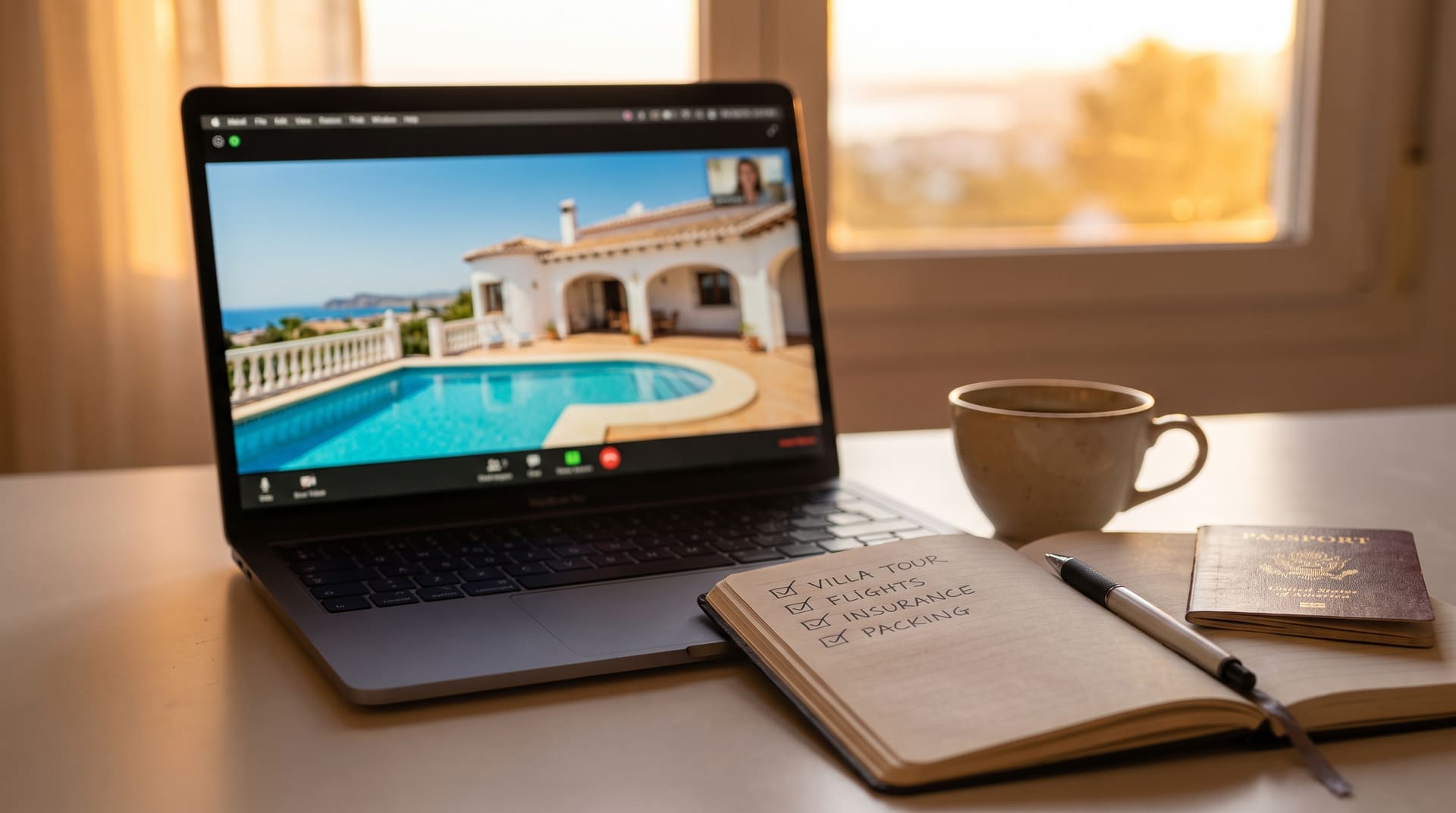
Can you buy an apartment in Spain without ever flying over? Yes — thousands of buyers from the US and other non-EU countries do it every year. The tools are well established: video tours, an independent Spanish lawyer, a power of attorney (POA), online signing and a smart currency transfer. Below is how to run a remote purchase safely without losing money on the exchange rate or on legal risk.
Can I buy property in Spain remotely?
Yes. Non-residents regularly buy at a distance. A physical visit becomes optional, not required: you can obtain the NIE through a consulate or by power of attorney, and your lawyer can sign the deed before the notary on your behalf under a power of attorney (poder notarial / POA). You do not have to fly over at any stage.
Step by step: a remote purchase
Step 1. Video tours and virtual shortlisting
Instead of trips — live video tours of properties, floor plans, and reports on the surroundings and amenities. A good agent runs a real-time video walkthrough, shows the views, the condition of the home and the neighbourhood, and answers questions. For new-builds, add renders, layouts and construction schedules (see off-plan new-builds).
Step 2. An independent lawyer
As with any purchase, appoint an independent abogado (not the seller's lawyer). They check the nota simple, debts, charges and the legality of the build — covered in detail in the non-resident buyer guide.
Step 3. Power of Attorney (poder notarial)
The key instrument of a remote purchase. You grant a specific power of attorney (poder notarial) to your Spanish lawyer, signed either:
- before a notary in your own country with an apostille (and a sworn translation into Spanish), or
- at a Spanish consulate abroad.
The POA lets the lawyer, on your behalf: obtain the NIE, open a bank account, sign the reservation and the escritura, and pay taxes — all without you present. Insist on a specific POA that lists exactly the powers granted (this purchase, these accounts) rather than a broad general one, and set an expiry. It is a standard, safe instrument when the lawyer is independent and vetted, and it can be revoked at any time before it is used.
Step 4. A digital NIE and remote bank account
You do not need to fly in for either. The NIE can be issued through a Spanish consulate in your country or obtained by your lawyer under the POA. For the bank account, several Spanish banks now allow non-resident accounts to be opened remotely with certified copies of your passport and NIE plus source-of-funds evidence, or your lawyer can open it under the POA. Both should be in place before completion, because the account details go on the deed and the notary traces the payment from it.
Step 5. Moving money and currency (FX)
Most buyers use a specialist currency broker rather than a high-street bank: on large sums this saves 2–4% versus retail exchange rates, and a forward contract can lock today's rate so a swing between arras and completion does not blow your budget. Funds go to your Spanish account or the lawyer's client account. Always keep proof of the source of funds — you need it for AML checks and for future capital-gains calculations. On a €300,000 purchase, a 3% FX saving is €9,000, so this step is worth real attention, not an afterthought.
Step 6. Online signing and completion
The reservation and deposit contract are often signed electronically with a qualified e-signature. The final deed before the notary is signed by your lawyer under the POA. After registration at the Land Registry you become the owner, and keys and documents are handed over remotely (couriered, or held by your lawyer). Your lawyer then transfers the utilities and community direct debits into your name — so a home can be fully yours, and running, without you ever landing in Spain.
How to choose a remote-buying lawyer
Because you cannot walk into the office, vetting the lawyer is the single most important safeguard. Look for:
- Independence — not recommended by, or paid by, the seller or developer.
- Registration with a Spanish bar (Colegio de Abogados) — verifiable online.
- A clear, written fee (typically ~1% + IVA) and a client account for your funds.
- English-language communication and references from past overseas buyers.
- Willingness to provide a written due-diligence report before you commit money.
A remote-purchase timeline
| Week | Milestone |
|---|---|
| 1–2 | Appoint lawyer, sign & apostille the POA |
| 2–3 | Video tours, shortlist, reservation |
| 3–4 | NIE + remote bank account under POA |
| 4–5 | Due diligence, arras, deposit via broker |
| 6–10 | (Mortgage if any), FX transfer, notary completion |
| +2–8 | Registration, utilities switched to your name |
Managing the property from abroad
Buying remotely is only half the story — most overseas owners also manage from a distance. Before completion, ask your lawyer to set up the essentials on your behalf: utility contracts and community fees on direct debit, the annual IBI payment, buildings and civil-liability insurance, and a nominated fiscal representative for Modelo 210 filings (see the taxes guide). If you intend to let, appoint a local property manager for keys, cleaning, guest check-in and maintenance, and confirm the property can be let legally under the 2025 rental rules first. A reliable person on the ground is what turns a remote purchase into a genuinely hands-off asset.
Is it safe to buy remotely from the US?
Yes — provided you follow the rules:
- Only an independent Spanish lawyer (not the seller's).
- Mandatory checking of the nota simple and absence of debts.
- Payments only into the lawyer's client account or via a bank guarantee for off-plan — never private accounts.
- An apostilled power of attorney, executed before a notary or at a consulate.
- Account for the double-taxation treaty between your country and Spain in advance (see the taxes guide).
Remote-buying checklist
| Stage | Tool | What to watch |
|---|---|---|
| Shortlisting | video tours, plans | live walkthrough, views, area |
| Lawyer | independent abogado | nota simple check |
| ID | NIE via consulate/POA | early, before completion |
| Authority | POA + apostille | a specific list of actions |
| Money | currency broker | save 2–4%, proof of funds |
| Signing | online + notary via POA | lawyer's client account |
Risks and safeguards
Remote buying is safe when structured correctly, but the risks are worth naming so you can neutralise each one:
- Rogue "agent" with no seller mandate → only pay once your independent lawyer holds the nota simple and confirms the seller's title.
- Deposit into a private account → pay only into the lawyer's client account or a bank-guaranteed escrow (off-plan).
- A property that does not match the video → insist on a live walkthrough (not edited clips), floor plans and, ideally, an independent surveyor's report.
- FX losses between arras and completion → use a broker and consider a forward contract.
- Over-broad POA → grant a specific power, with an expiry, revocable at will.
Specifics for US and non-EU buyers
- Rental and imputed-income tax rate — 24% (non-EU), with no expense deductions (see the taxes guide).
- Non-resident mortgage — 60–70% of value, so you need 30–40% cash (see the mortgage guide).
- Buying does not grant residency; relocation needs a separate visa (see the after-Golden-Visa guide).
- Factor in the double-taxation treaty between your country and Spain so income and gains are not taxed twice.
- Time-zone differences are handled with pre-agreed windows for video calls and signings.
Virtual viewings done right
The video tour is where remote buyers most often get caught out, so treat it as a structured inspection rather than a highlight reel. Ask the agent to walk through in one continuous live take, phone in hand, so you control the route: show the water pressure by running the taps, open every window to reveal the real view (not a wide-angle crop), pan across ceilings and corners for damp or cracks, and walk the street and building entrance. Request the floor plan with real measurements, the energy certificate, and daytime and evening footage if noise or light matter. For a new-build, add the renders, material specifications and construction schedule (see off-plan new-builds). Where the numbers are large, commission an independent surveyor or architect for a few hundred euros — cheap insurance against a costly surprise you could not see on a screen.
What happens next
Remote buying is about trust in the team on the ground. Start with an independent lawyer and a currency broker, prepare an apostilled power of attorney and shortlist properties by video tour. Browse regions and new-builds, and to arrange video tours and a turnkey purchase — send a request and a specialist will build the whole process remotely.